McKinsey Sea Wolf: Complete Guide

Learn how the 30-minute Ocean Cleanup game works across three sites, then prepare with a detailed phase walkthrough, practical strategy, and realistic McKinsey Sea Wolf practice.

Last updated: September 2026

McKinsey Solve walkthrough

On this page

McKinsey Sea Wolf guide: overview and format

McKinsey Sea Wolf is a constraint-satisfaction game within the McKinsey Solve assessment. You act as a microbiologist developing treatments for three contaminated ocean sites, selecting microbe combinations that satisfy each site’s requirements within a 30-minute window.

You may also see it called Ocean Cleanup, Ocean Treatment, the microbe game, or simply the Sea Wolf game. These names refer to the same Solve module.

Duration
30 minutes in one sitting
Structure
Three sites, each moving through four phases
Core skills
Constraint satisfaction, rapid arithmetic, pattern recognition, and prioritisation
Main challenge
Preserving enough time for final optimisation while processing unfamiliar information quickly

How each site works

Each microbe has one trait and three numerical attributes with values from 1 to 10. Each site provides target ranges for all three attributes, one desired trait, and one undesired trait. Your final output is a treatment of exactly three microbes whose attribute averages land inside the target ranges, include the desired trait, and avoid the undesired trait.

Where Sea Wolf sits in McKinsey Solve

Sea Wolf is commonly completed alongside the 35-minute Redrock module. A 65-minute invitation often refers to those two games; 85- and some 95-minute invitations may add a Sustainable Futures Lab format. These are reported patterns rather than a universal schedule, so your invitation and on-screen instructions take priority. The McKinsey Solve Game guide explains the complete sequence.

What the task appears to evaluate

The visible work exercises analytical thinking: understanding constraints, filtering information, adapting across stages, and reaching a defensible answer under time pressure. McKinsey does not publish the weight assigned to individual clicks, phases, or treatment results in its broader assessment methodology.
The four McKinsey Sea Wolf phases

The same sequence repeats across the three sites. Early decisions organise the work; Prospecting and Treatment shape the final pool and submitted treatment.

  1. Profiling

    Select two characteristics to prioritise. This signals how you reason but does not change which microbes appear later in the current practice model.

    • Choose the desired trait and the target attribute that is the greatest outlier from the midpoint when you need a fast, logical rule.
    • Treat this as an orientation decision and move on. Spending extra time here does not improve the final treatment pool.

    Pacing target: under 30 seconds.

  2. Categorising

    Sort ten microbes into three buckets: keep for the current site, save for the next site, or return. You can see the current requirements and one clue about the next site.

    • Current site: keep a microbe that meets at least two current targets and does not have the undesired trait.
    • Next site: save a microbe that matches the next-site clue but is not suitable for the current site.
    • Return: reject a microbe that is useful for neither the current nor the next site.

    This phase rewards fast, consistent classification rather than exhaustive calculation.

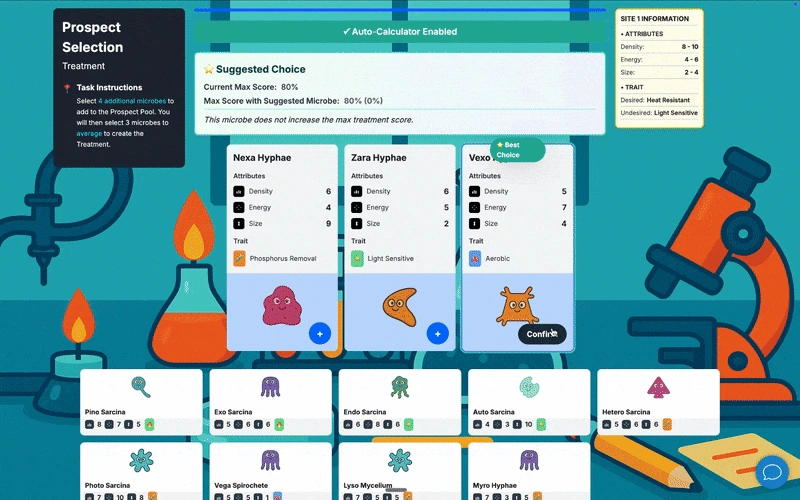
  3. Prospecting

    Build the pool used in Treatment. You begin with six microbes and add four more through successive choices, finishing with a pool of ten.

    • Avoid microbes with the undesired trait whenever a viable alternative exists.
    • Look for a balanced pool that can combine toward all three numerical targets; individual microbes do not each need to sit inside every range.
    • Make sure at least one credible desired-trait option reaches the final pool.

    Rough filtering is usually faster than trying to solve every possible trio during selection.

  4. Treatment

    Choose exactly three microbes from the pool and submit the treatment. Their three attribute averages and desired or undesired traits determine the displayed treatment effectiveness.

    • Check all three attribute sums against their converted target windows.
    • Include at least one microbe with the desired trait.
    • Avoid every microbe with the undesired trait.

    This is the final optimisation step, so protect most of your remaining time for it.

McKinsey Sea Wolf strategies and calculations

Time management is the central challenge. Move through Profiling and Categorising with consistent rules so that Prospecting and Treatment receive the attention they need.

Memorise the constraints before sorting

Spend roughly 15–20 seconds noting the desired and undesired traits, the next-site clue, and the three target ranges. When a range spans two values, memorise the lower bound and mentally add two rather than repeatedly looking back and forth.

Use one categorisation rule

  • Two or more current-site matches and no undesired trait: keep for the current site.
  • A next-site match but insufficient current-site value: save for the next site.
  • An undesired trait or too few useful matches: return, unless the next-site clue makes it useful there.

The Sea Wolf Cheat Sheet keeps these bucket rules in a compact reference.

Filter roughly during Prospecting

Detailed optimisation during every choice is theoretically attractive but usually too slow. Rough filtering is more practical: avoid undesired traits, retain a desired trait option, and build numerical variety. Treatment is the place to optimise the final trio.

Calculation shortcut: compare sums

Instead of averaging three values and then comparing the result with a target range, multiply both range bounds by three and compare the sum. A target of 3–5 becomes a valid sum window of 9–15. Values of 7, 4, and 5 total 16, so that trio misses the range.

Treatment effectiveness and worked example

Each site starts at 100% treatment effectiveness. The displayed treatment model deducts 20% for each attribute average outside its range, 20% when the desired trait is absent, and 20% when any selected microbe has the undesired trait. These five treatment criteria do not reveal how McKinsey weights the broader Solve assessment.

Worked example

Site requirements: Attribute 1 = 3–5, Attribute 2 = 5–7, Attribute 3 = 2–4; desired trait = Adaptive; undesired trait = Volatile.

Selected microbes: A (3, 6, 2, Stable), B (5, 7, 5, Adaptive), and C (4, 5, 2, Stable).

The averages are 4.0, 6.0, and 3.0. All sit inside their ranges, Adaptive is present, and Volatile is absent, producing 100% treatment effectiveness.

If no perfect combination exists, minimise missed criteria. When two combinations have equal displayed effectiveness, avoiding the undesired trait is usually the cleaner tiebreaker because it prevents a known negative condition.

How to prepare for McKinsey Sea Wolf

A short orientation followed by realistic timed practice is more useful than extensive passive research. Use this sequence to turn the interface and calculations into habits.

  1. Understand the complete flow

    Learn what each phase contributes and when the final pool is formed. Use the cheat sheet until the three categorisation buckets feel automatic.

  2. Practise the arithmetic shortcut

    Convert average ranges into sum windows and check three values quickly. The goal is fluency, not advanced mathematics.

  3. Use the solver as a learning tool

    Compare your choices with valid combinations to see why a trio succeeds or fails. Use it between timed runs, not as a substitute for them.

  4. Complete a full timed session

    Work through all three sites without pausing. Review where time disappeared—often Categorising—and adjust one pacing rule before the next attempt.

Practise McKinsey Sea Wolf with the simulator

The Sea Wolf simulator covers all four phases across three timed sites, with the same kinds of attributes, traits, constraints, and treatment decisions described in this guide. It is independent practice and is not affiliated with McKinsey.

Sea Wolf simulator showing the microbe treatment interface
Sea Wolf practice in the Solve Games Guide simulator
Explore the Sea Wolf simulator

Use the Sea Wolf solver between attempts

The solver calculates averages and checks constraints to identify valid combinations. It accelerates pattern learning during preparation, but it is not available in the assessment and should sit alongside full timed practice.

Explore the Sea Wolf solver

Sea Wolf resources and related guides

McKinsey Sea Wolf FAQ

Clear answers about the format, names, scoring explanation, preparation, and practice.

What is Sea Wolf in the McKinsey assessment?

Sea Wolf is a 30-minute constraint-optimisation module in McKinsey's digital Solve assessment. Candidates select microbe combinations to meet site-specific treatment targets across three ocean sites. It is also called Ocean Cleanup, Ocean Treatment, or the microbe game.

Is Ocean Cleanup the same as Sea Wolf?

Yes. Ocean Cleanup, Ocean Treatment, the microbe game, and Sea Wolf are names used for the same module inside McKinsey Solve.

How long is the McKinsey Sea Wolf game?

Sea Wolf lasts 30 minutes and covers three sites. It is completed in the same sitting as the other modules listed in your invitation, and you cannot pause mid-module.

How is Sea Wolf scored?

Each site starts at 100% treatment effectiveness. Deductions of 20% apply for each attribute average outside its range, missing the desired trait, or including an undesired trait. McKinsey does not publish how these treatment results are weighted in its broader assessment methodology.

What makes Sea Wolf difficult?

The challenge is primarily time-based. Processing microbe attributes, applying constraints, and making selections must happen faster than most candidates initially expect. Practice under timed conditions reveals where improvements are needed.

How should I allocate my time?

Spend minimal time on Profiling, move efficiently through Categorising, and reserve most of the clock for Prospecting and Treatment, where your choices directly shape the final treatment.

Is it possible to achieve 100% on every site?

Not always. Some site configurations may not offer a perfect-scoring combination. When no perfect combination exists, choose the option that minimises the number of missed criteria.

Should I use a solver during practice?

A solver accelerates learning by showing which combinations work without manual calculation. It helps build pattern recognition for the assessment, when the practice solver is not available.

What if no perfect combination exists?

Choose the combination that minimises penalties. Avoiding the undesired trait is usually the safer tiebreaker when two options produce the same treatment score.

Can I practice McKinsey Sea Wolf for free?

McKinsey does not publish a full practice version. Solve Games Guide includes one free Sea Wolf session with the complete four-phase flow. No credit card is required.

Choose Your Package

Select the package that fits your preparation needs. All packages include 2-week access.

You only get one attempt at the McKinsey Solve Games. This costs less than a single interview coaching session, and prepares you for the actual filter.

Most candidates choose this

Ultimate

The complete toolkit: simulations, solver, cases, and both unique versions of the Sustainable Futures Lab game. Everything you need to prepare with confidence.

  • Sea Wolf Solver
  • Sea Wolf Simulations
  • All 5 known McKinsey Solve formats
  • 20+ full-length Redrock case studies
  • 5 Standard Sustainable Futures Lab Missions
  • 5 Lab Leader Sustainable Futures Lab Missions
  • 50% refund if none of our 5 Redrock formats appear
  • 100% refund performance guarantee
  • Higher Assessment Success Rates

The 3 hour prep

Three-hour prep for candidates who want one Redrock case per template, two Sustainable Futures Lab missions, and the Sea Wolf solver.

  • Sea Wolf Solver
  • All 5 known McKinsey Solve formats (one of each)
  • 5 Redrock case studies
  • 2 Standard Sustainable Futures Lab Missions
  • 2 Lab Leader Sustainable Futures Lab Missions
  • Best last-minute prep

Redrock Cases

Structured practice on 20+ full-length consultancy-style case studies modeled on the 5 known McKinsey Solve assessment formats.

  • All 5 known McKinsey Solve formats
  • 20+ full-length Redrock case studies
  • Best budget choice

Sea Wolf + Sustainable Futures Lab

Master Sea Wolf scoring and simulation, plus both unique versions of the Sustainable Futures Lab game.

  • Sea Wolf Solver
  • Sea Wolf Simulations
  • 5 Standard Sustainable Futures Lab Missions
  • 5 Lab Leader Sustainable Futures Lab Missions

Solver Only

Best for beginners who want to learn scoring logic quickly.

  • Sea Wolf Solver

Put your McKinsey Sea Wolf strategy into practice

Start with one free session covering all four phases across three timed sites.